Alberta’s Illegal Dumping Crisis: Smith Proposes Bigger Fines—and Farmers Have the Footage
Real footage from Calgary-area farmland puts people and property behind the numbers. Danielle Smith’s government has announced proposed fines of up to C$100,000 for individuals and C$1 million for corporations—but the changes still need legislative approval.
October 3, 2026 · By Justin Plosz · Alberta, Canada · Community · 13 min read read
A farmer’s field is not a free landfill
The picture at the top of this article is not an illustration, a stock photograph or an AI reconstruction. It is a farmer-supplied photograph published in [CityNews Calgary’s July 30 report](https://calgary.citynews.ca/2026/07/30/illegal-dumping-calgary-farmers/), credited to Mitchell Konschuk. It shows people beside an open rental truck on Calgary-area farmland during an incident the farmers described as illegal dumping. The associated report includes footage of the confrontation. PRC is not identifying those individuals or claiming that the image proves a conviction.
The larger problem is familiar to Albertans who have found a sofa in a ditch, renovation debris beside a rural road, a mattress near a neighbourhood fence or bags of someone else’s waste on their own property. The person leaving the load avoids the work of proper disposal. Someone else inherits the cleanup, the uncertainty about what is in it and the cost of getting it to an approved facility.
On September 30, Premier Danielle Smith’s government announced a provincial response: substantially higher proposed dumping penalties and tighter regulation of higher-risk waste facilities. The announcement is significant, but it is important to report what happened accurately. Alberta announced plans for legislation; it did not announce that every proposed fine and jail provision was already law. This article explains the proposal, the documented incidents behind the concern, the videos readers can examine themselves and the practical steps Albertans can take now.
Read Alberta’s September 30, 2026 announcement
Watch: the actual Calgary-area incident reported by CityNews
CityNews reporter Joel Mendelson’s report describes farmers catching people unloading garbage on land along Calgary’s northern edge. According to the farmers’ account, the individuals initially began picking up the waste after being confronted. The farmers said that when they moved away to contact police, the individuals allegedly dumped the material again and left. That sequence is the farmers’ reported account, not a court finding established by PRC.
The report identifies cattle and grain producers Alex Hunter and Carter Mitschke, along with producer Mitchell Konschuk. Mitschke can be heard confronting the people involved. Hunter told CityNews that the problem had become more brazen and described a separate incident involving a burned-out car left in a driveway. Konschuk pointed to multiple nearby dumping locations.
This is the authentic news report containing the farmer-recorded footage—not actors portraying dumpers and not unrelated footage from another country. The people shown are not named in this article, and no charge or conviction involving them is established by the sources reviewed. Viewers should not try to identify, contact or confront them. Evidence belongs with investigators.
CityNews Calgary / Joel Mendelson, published July 30, 2026. Approximately 2 min 34 sec. Includes farmers’ footage of an alleged dumping incident and their account of what happened. The report is embedded through the publisher’s player; it does not establish a conviction.
Watch the farmer-recorded incident in the original CityNews report
What Danielle Smith’s government just announced
The [official September 30 release](https://www.alberta.ca/announcements.cfm?xID=97861846FC3EC-D404-1227-59D5AC82E7FF8A1F) says Alberta plans to introduce legislation this fall amending the Environmental Protection and Enhancement Act. The proposal has two main parts: tougher penalties for illegal dumping and stronger oversight of higher-risk waste transfer and storage facilities.
Smith framed the issue around environmental protection, private property and the people left paying for cleanup. In the release, she said: “Illegal dumping damages our environment, violates private property and leaves Albertans paying for someone else’s mess.” Her government says the proposed penalties are intended to make offenders, rather than communities and landowners, bear meaningful consequences.
Environment and Protected Areas Minister Grant Hunter spoke to the waste-site oversight component. Justice Minister Mickey Amery described the proposed dumping penalties as the most severe in Canada. That national comparison is the minister’s claim; this article does not present it as an independent province-by-province legal ranking. Public Safety and Emergency Services Minister Mike Ellis said the changes would strengthen enforcement and officers’ tools.
The official news conference is included below so readers can review the government’s presentation directly. It explains the policy announcement; unlike the farmer’s video, it is not footage of a dumping incident.
YourAlberta / Government of Alberta: “Getting tough on illegal dumping,” September 30, 2026. Official announcement video. The penalties discussed are proposed and subject to legislative approval.
Watch Alberta’s full September 30 news conference
The proposed penalties, in Canadian dollars
For individuals, the government says the relevant maximum fine would rise from C$50,000 to C$100,000, with a new proposed minimum of C$10,000. That is a proposed range of **C$10,000–C$100,000**, not a flat C$100,000 ticket for every incident.
For corporations, the government says the maximum would rise from C$500,000 to C$1 million, with a proposed minimum of C$100,000. The proposed corporate range is therefore **C$100,000–C$1 million**. The C$1-million figure is the corporate maximum; it should not be presented as the proposed fine for an ordinary individual.
The release also describes proposed jail terms for individuals ranging from **30 days to six months**. Alberta’s accompanying information page says courts would be able to impose jail sentences “in certain circumstances.” Neither source supports telling readers that every person accused of dumping would automatically be jailed. The eventual legislation, offence provisions, evidence and court decisions would govern how penalties apply.
There is also a municipal layer. Calgary’s own April 21, 2026 release says dumping is prohibited by city bylaws and offenders can face fines up to C$10,000. That existing municipal maximum is a different statement from the proposed provincial minimum of C$10,000. Which enforcement route applies to a particular case is not determined by a headline.
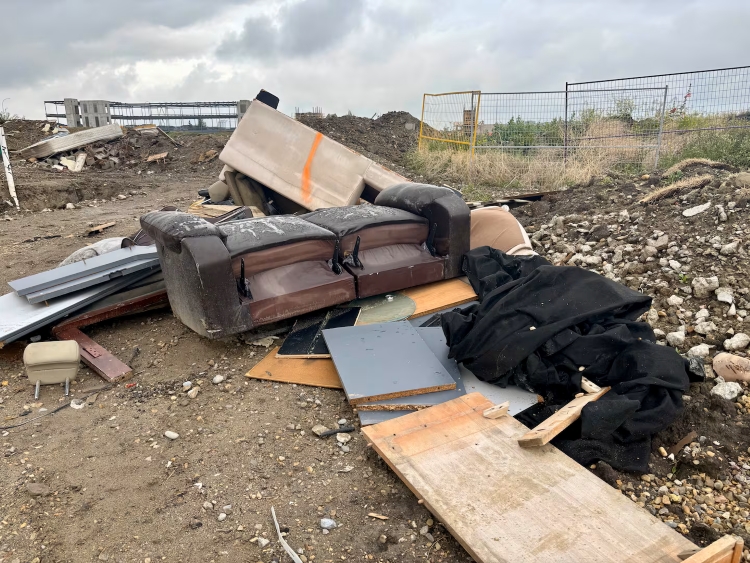 Garbage and furniture left in Saddle Ridge, northeast Calgary, on August 13, 2026. Photo credited to CTV and reproduced on Alberta’s September 30 announcement page. This aftermath photograph does not identify who left the waste.
Check Alberta’s proposed penalties and reporting guidance
Proposed does not mean passed: what remains to be confirmed
As of this article’s October 3, 2026 source check, the announcement and provincial information page describe the changes as pending legislative approval. The release says legislation is planned for the fall. The sources reviewed do not establish an enacted bill, a commencement date or a final offence-by-offence sentencing framework.
That distinction matters for residents, businesses and anyone sharing the story. An announcement can describe the government’s intended direction without making the new penalties enforceable that day. Existing laws and municipal bylaws still apply; dumping is not suddenly permitted while the government pursues amendments.
Before describing these measures as law, the items to verify are the introduced bill and its wording, legislative passage, royal assent and any coming-into-force provisions or regulations. Readers should use the [Legislative Assembly’s bills and amendments page](https://www.assembly.ab.ca/assembly-business/bills-and-amendments) and the province’s linked updates rather than assuming a social-media clip supplies an effective date.
For now, the accurate summary is: Smith’s government has announced a tougher proposed framework, with much larger fines and possible jail time. It has not been established in the reviewed sources that those new penalty ranges are already in force.
Check Alberta’s legislative record for the bill and its status
Calgary’s numbers show the workload—not 30,000 proven offenders
Alberta’s announcement cites Calgary as an example of the scale of the problem. It says that in 2025 the city received about **30,000 complaints** and almost **9,000 service requests** concerning illegal dumping on municipal property. It also reports **165 tickets and three fines**.
Those numbers should not be stretched beyond what the source says. A complaint is not the same thing as a unique dumping incident, a service request is not a conviction, and a ticket is not necessarily a final paid fine. The release does not explain all overlap between complaints and requests or how the tickets and fines relate. It would be misleading to convert these figures into a precise conviction rate or to say Calgary caught 30,000 offenders.
The city’s [April 21 release](https://newsroom.calgary.ca/illegal-dumping-hurts-calgary-neighbourhoods/) says the problem has become more severe in recent years, especially in northeast communities. It warns that dumped waste creates safety risks, attracts pests, presents fire hazards and redirects crews from other work. Those are practical consequences for neighbours and municipal services, not just an argument about how untidy a pile looks.
A useful follow-through measure will be whether the announced changes produce better evidence collection, identified responsible parties, cleanup and enforceable outcomes—not simply whether a maximum fine grows on paper.
Read Calgary’s explanation of the impacts and disposal options
Watch: residents describe the buildup in Saddle Ridge
A separate [CityNews report published August 20](https://calgary.citynews.ca/2026/08/20/illegal-dumping-northeast-calgary/) documents discarded furniture and household waste in Calgary’s Saddle Ridge community. Reporter Jayden Wasney spoke with residents concerned about repeated additions to the piles. The city acknowledged receiving multiple reports from the area.
This report is included to show the neighbourhood impact, not as a second proven case against the people in the farmer’s footage. The accompanying pictures show abandoned waste. They do not establish who dumped it, and the sources reviewed do not link the Saddle Ridge piles to the farmland incident.
Calgary says large items left near fences, carts or dumpsters are not collected as ordinary cart waste. Leaving a mattress beside a bin does not turn it into an approved disposal arrangement. Residents need to use an appropriate bulky-item service or facility instead.
CityNews Calgary / Jayden Wasney, August 20, 2026. Approximately 1 min 40 sec. A report on waste piles and residents’ concerns in Saddle Ridge; this is neighbourhood-impact footage, not identification of the people responsible.
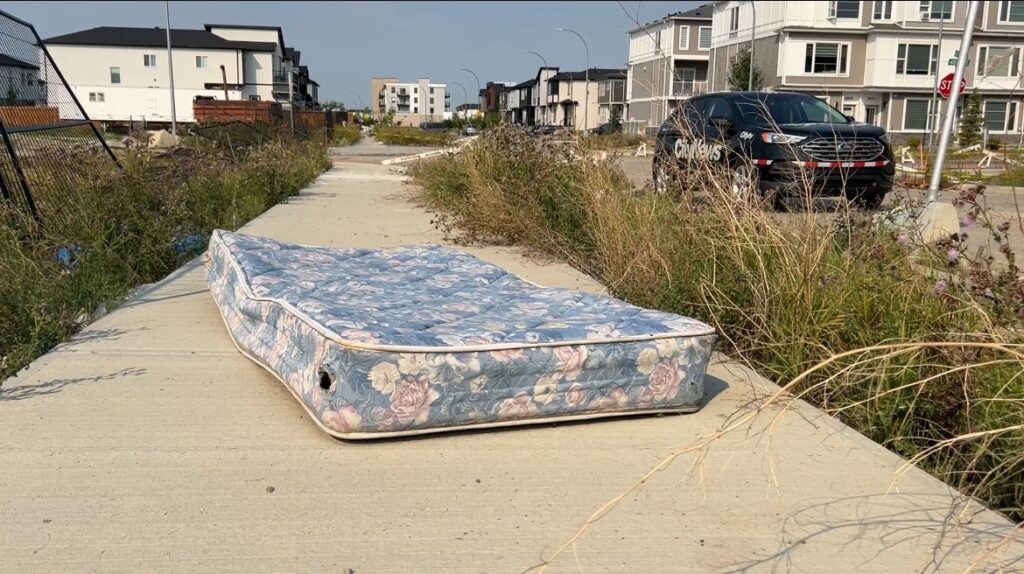 A mattress left in Saddle Ridge, northeast Calgary, on August 20, 2026. Photo: CityNews / Jayden Wasney. The image documents the discarded item, not the identity of the person who left it.
Watch the original Saddle Ridge report and view its photographs
The other half of the announcement: higher-risk waste facilities
The September 30 proposal is not limited to people leaving garbage in a ditch. Alberta also plans to strengthen oversight of waste transfer and storage facilities that handle larger volumes or retain waste for longer periods. Under the proposal, higher-risk facilities would need provincial registration and additional operating requirements.
The government expects the new registration rules to apply to about **150 of Alberta’s 684 waste transfer and storage sites**. Lower-risk operations with shorter retention periods, limited inventory and specific waste types could continue under the existing notification process. The stated approach is to focus added oversight on higher-risk operations rather than apply the same new requirements to every site.
The release does not provide a final list of affected facilities or enough detailed thresholds to tell every operator whether it will fall inside the new category. Operators should watch for the actual legislation, regulations and ministry guidance before assuming their existing notification status will remain sufficient.
An authorized waste facility and an illegal dumping site are not interchangeable. Including waste-site oversight in the same announcement does not mean a registered business has committed an offence. The regulatory question is how waste is stored and managed; the dumping question is whether waste has been deposited unlawfully.
Find Alberta’s waste legislation and regulatory resources
Why farmers and private landowners are especially exposed
CityNews’ farmland report puts the burden in concrete terms: a landowner who did not create the waste still has to consider whether it is hazardous, how to move it safely and where it can legally go. Rural locations can leave the material out of sight until someone checks a field, driveway or road allowance.
The province says illegal dumping harms water quality, wildlife and public safety, as well as municipalities, farmers and landowners. Calgary lists construction and renovation materials among commonly dumped items, alongside furniture, mattresses, barbecues and yard waste. An abandoned load may be more complicated than a few bags of household garbage, but its contents should not be guessed from a photograph.
If you find suspicious waste, avoid opening containers or disturbing unknown substances. Keep people and animals away where safe, document the location and contact the appropriate authority. Do not assume that an unlabelled drum is harmless or that renovation material is safe to handle without assessment.
For a property owner, keeping a dated record of what was found, photographs, an incident reference number and any legitimate cleanup invoices can help explain the case to investigators. This is practical documentation advice—not a promise that a particular cleanup bill will be reimbursed or that the proposed law guarantees compensation.
Read the province’s environmental and landowner guidance
How to report dumping in Alberta—and what evidence helps
**Environmental concern or suspicious waste:** Alberta’s current guidance directs people to its 24-hour environmental response line, **1-800-222-6514**. Explain what you observed and where it is. The announcement asks people who see dumping or discover suspicious waste to report promptly and contact their municipality.
**Public or Crown land:** Call **310-LAND (5263)**. **Municipal land:** Contact the relevant municipality. In **Calgary and Edmonton**, illegal-dumping and bylaw concerns can be reported through **311**, including the cities’ online or app channels. Do not assume every Alberta municipality uses the same local number. Call **911** if there is an immediate threat to life or safety, such as an active fire or violence—not as the routine route for an old discarded sofa.
Calgary’s official guidance asks witnesses to record the location, time, vehicle description, licence plate if safely visible, descriptions of people and the items being dumped. A photograph or video can help if it can be taken safely. If you only find a pile afterward, photograph the waste and give a specific location; do not invent a suspect.
Keep the original photo or video file and share it privately with investigators. Record your own observations separately from anything someone else told you. Avoid editing the only copy, following a vehicle, entering private property without permission or escalating a confrontation to obtain a better shot. Public accusations are not a substitute for a report.
Calgary says a peace officer usually begins reviewing a service request within 7–10 business days and may request a witness statement or further information. That is the city’s described process, not a guaranteed cleanup time or the response standard for every Alberta agency. If conditions change or a new danger appears, tell the authority handling the report.
Use Calgary’s official reporting checklist and 311 links
Legal disposal: the options are wider than leaving it in a ditch
**In Calgary**, approved options include properly used household carts, City Eco Centres for bulky items and renovation materials, and licensed private junk-removal services. Use the city’s [What Goes Where tool](https://www.calgary.ca/waste/what-goes-where/default.html) to check a specific item. Fees and acceptance rules depend on the material and service. Calgary’s community cleanups are seasonal: the 2026 announcement described events from April through September, so an October reader should check the schedule rather than assume an event is running today.
**In Edmonton**, the city directs residents with bulky items to [Eco Stations](https://www.edmonton.ca/programs_services/garbage_waste/eco-stations), scheduled Big Bin events or the Edmonton Waste Management Centre. Fees may apply. Edmonton also warns that leaving an item beside a large dumpster does not make it a scheduled pickup: disposal responsibility can fall to the property owner. Even natural material such as dirt or yard waste cannot simply be dumped in parks or green space.
**Elsewhere in Alberta**, contact your county, town or city for landfill, transfer-station, recycling and bulky-item options. The province links to the [Alberta Recycling Management Authority depot finder](https://www.albertarecycling.ca/depot-finder/) and its own household hazardous-waste guidance. Paint, chemicals, electronics and other special materials may require a specific destination; do not assume a regular bin or every transfer station accepts them.
**If hiring a hauler**, ask where the material will go and keep the quote, invoice and available disposal documentation. An unusually cheap removal offer is not evidence that someone is a dumper, but an unclear destination is a reason to ask more questions. Responsible disposal has a real cost; paying someone to remove a load should not mean unknowingly moving the problem onto a neighbour’s field.
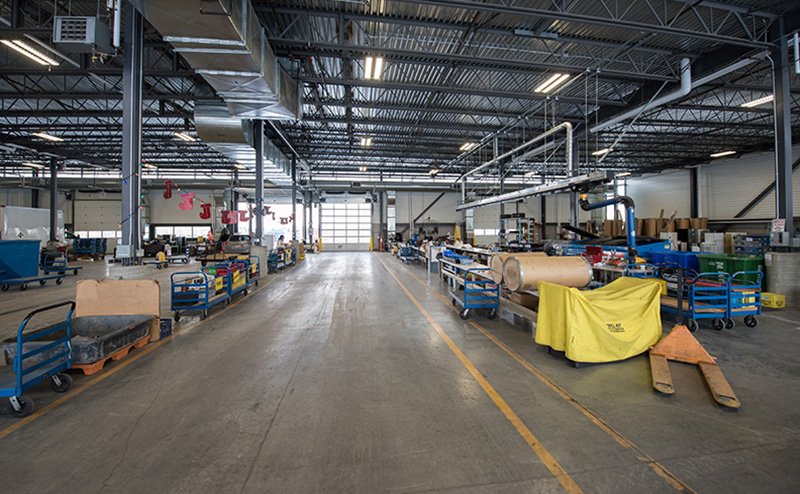 An Edmonton Eco Station interior, pictured on the City of Edmonton’s official illegal-dumping information page. Photo: City of Edmonton. An approved disposal option, not an illegal dumping scene.
Check Edmonton’s disposal options, reporting links and current facility information
What to watch next—and how this article treats the evidence
The next test is implementation. Watch for the bill, the final offence and sentencing language, commencement provisions, the risk thresholds for waste-site registration and the resources available for investigation. Bigger maximum penalties can signal seriousness, but cases still need usable evidence and a lawful enforcement process.
The burden on communities is already documented. The farmer-recorded report shows why landowners want action, and Calgary’s own releases explain the municipal workload. The announced proposal responds to those concerns. Whether it reduces dumping will depend on what is enacted and what happens afterward, not on treating a policy announcement as a completed cleanup.
**Editor’s note and media credits:** This is a sourced news explainer checked against Alberta’s September 30 announcement and official guidance, Calgary and Edmonton reporting pages, and CityNews’ July 30 and August 20 reporting, as of October 3, 2026. The farmer’s photograph is credited to Mitchell Konschuk via CityNews. The Saddle Ridge announcement image is credited to CTV via Alberta; the mattress image is CityNews / Jayden Wasney; the Eco Station image is City of Edmonton. Images remain hosted at their original public sources, and videos use the publishers’ own players with direct source links. Availability, advertising and regional playback restrictions are controlled by those publishers.
No AI-generated image or reenactment is presented as evidence. The people in the farmland photograph and footage are not identified by PRC, and the sources reviewed do not establish their charges or convictions. The footage is attributed to the published report and farmers’ account; unrelated waste piles are not used to accuse those individuals. Readers with firsthand evidence should contact the appropriate authorities, not organize a public identification campaign. PRC will correct factual errors and update the article when the legislative status is verified.
Follow the province’s current illegal-dumping information and updates
Key takeaways
- Alberta announced the proposed crackdown on September 30, 2026; legislative approval and the effective date must be verified before calling the new penalty ranges law.
- Proposed individual fines would range from C$10,000 to C$100,000; proposed corporate fines would range from C$100,000 to C$1 million.
- The province describes possible jail terms of 30 days to six months in applicable circumstances, not automatic jail for every allegation.
- Authentic farmer-supplied photography and the CityNews July 30 report show an alleged Calgary-area dumping incident; no conviction of the people shown is established here.
- The province cites about 30,000 Calgary complaints and almost 9,000 service requests in 2025; those are not 30,000 distinct proven offenders.
- About 150 of 684 waste transfer and storage sites are expected to face proposed higher-risk provincial registration requirements.
- Environmental concerns can be reported to 1-800-222-6514; public-land incidents to 310-LAND (5263); municipal incidents to the local municipality, including 311 in Calgary and Edmonton.
- Use approved disposal facilities and preserve original evidence for investigators; do not confront or organize public identification of the people in footage.
Frequently asked questions
- What did Danielle Smith announce about illegal dumping in Alberta?
- On September 30, 2026, Smith’s government announced plans for fall legislation increasing illegal-dumping penalties under the Environmental Protection and Enhancement Act and requiring provincial registration for higher-risk waste transfer and storage facilities. The measures remain proposed in the sources checked on October 3.
- How much are Alberta’s proposed illegal-dumping fines?
- The proposed ranges are C$10,000 to C$100,000 for individuals and C$100,000 to C$1 million for corporations. The C$1-million amount is a corporate maximum, not the proposed individual maximum. Existing municipal bylaw penalties are separate.
- Are the new penalties already law?
- Not established by the sources reviewed as of October 3, 2026. Alberta’s announcement says legislation is planned for the fall and the changes require legislative approval. The enacted wording and commencement date need to be verified before claiming the new rules are in force.
- Could illegal dumping lead to jail under the proposal?
- The September 30 release describes proposed jail terms of 30 days to six months for individuals, and the province’s information page says courts could impose jail in certain circumstances. It does not say every dumping allegation would automatically result in imprisonment.
- Does this article show real people involved in dumping?
- Yes. The farmer-supplied photograph credited to Mitchell Konschuk and the embedded July 30 CityNews report document an alleged dumping incident on Calgary-area farmland. They are not AI images or reenactments. PRC does not identify the people shown or establish a charge or conviction against them.
- Where do I report illegal dumping in Alberta?
- For environmental concerns, call 1-800-222-6514. For public or Crown land, call 310-LAND (5263). For municipal incidents, contact the municipality; Calgary and Edmonton use 311. Call 911 for immediate threats to life or safety.
- What should I photograph or record if I witness dumping?
- If safe, record the location, time, vehicle description and licence plate, the items being dumped and what you personally observed. Keep original photo or video files for investigators. Do not chase, confront or publicly identify people to gather evidence.
- Can I leave a mattress or sofa beside a dumpster?
- Calgary and Edmonton say large items left beside carts or dumpsters are not collected as ordinary waste. Use an approved bulky-item facility or service, and check current fees and accepted materials.
- Which waste facilities would face new registration requirements?
- Alberta expects about 150 of its 684 waste transfer and storage sites to fall under the proposed higher-risk registration requirements. Lower-risk sites could remain under notification rules. Final thresholds and affected-site details were not established by the announcement.
← Back to PRC Newsroom · Public Relations Canada
Enable JavaScript to view the interactive version of this page.